Materials & Craftsmanship
How to Read Organic Mattress Certifications Before You Choose
An organic label can look like a clear promise. In practice, it may describe one fiber, a particular manufacturing stage, or a specific component—not necessarily the entire mattress. Learning what a certification covers helps you distinguish verified material claims from broad marketing language.
A mattress is a layered object: fabric, batting, foam or latex, springs, adhesives, thread, and sometimes fire barriers all meet within a single finished product. Each layer may have a different origin and production history. When a label says “organic,” the first useful question is not simply whether the claim sounds reassuring. It is: what, exactly, has been certified?
That distinction matters because organic mattress certifications do not all assess the same things. Some focus on agricultural production. Others address processing, chemical inputs, or the contents of a finished product. A certificate for organic cotton fabric, for example, does not automatically establish that the latex, wool, spring unit, or complete mattress has the same certification.
Reading the details is less like decoding a single seal and more like tracing a route through a landscape—from raw material to finished bed. With a little care, certification names can help you understand that route, compare products more fairly, and ask precise questions before making a choice.
Why organic mattress labels need context
The word “organic” is often used as though it describes a whole object in one stroke. A mattress, however, is assembled from materials that may come from different farms, factories, and countries. The cotton cover may be certified, while the inner foam is not. Latex may have a recognized certification, while the wool is described only as natural. A finished-product label may also apply to a defined product line or production facility rather than every item sold under a brand.
None of this automatically makes a product misleading or low quality. It means the scope of the claim matters. Certifications are tools for verifying particular requirements; they are not universal guarantees of every attribute a shopper might care about. A certificate may say something about fiber origin or processing without establishing mattress comfort, lifespan, durability, or suitability for a particular sleeper.
Likewise, “natural,” “eco-friendly,” “green,” and “chemical-free” are not interchangeable with a specific organic certification. These words can have varied meanings in product descriptions, and some are not backed by the same kind of independent standard. A useful comparison starts by separating exact, verifiable statements from general descriptions.
Understand the main parts of a certification claim
When you encounter a certification name, read the surrounding words as carefully as the logo. The claim usually has several parts: the standard, the material or product covered, the stage of production assessed, and the organization or certificate holder associated with it.
- The standard: Which certification program or specification is named?
- The material: Does it cover cotton, wool, latex, or another component?
- The scope: Does it apply to raw materials, processing, a facility, or the finished mattress?
- The evidence: Is there a certificate, transaction record, or other documentation that connects the claim to the product?
- The limits: What is not covered, and are any components outside the certification?
These questions prevent a common misunderstanding: assuming that a certified component makes every part of a mattress certified. If a description says “made with certified organic cotton,” that is a claim about cotton, not necessarily about latex, adhesives, thread, or the completed product. Clear product information should make those boundaries understandable.
GOTS: a standard associated with organic textiles
The Global Organic Textile Standard, commonly abbreviated as GOTS, is a textile-processing standard. It addresses organic fibers and requirements across defined stages of textile production. In a mattress context, the claim may relate to cotton fabric, textile components, or a qualifying finished textile product. The exact scope depends on the certified item and the documentation behind the claim.
A GOTS reference should not be read automatically as proof that every mattress component is organic. A textile certification does not, by itself, establish the status of a latex core or metal spring unit. Nor does the presence of a GOTS logo on a website necessarily show that the particular mattress model, fabric, or production chain is covered. Ask which component is certified and request documentation that identifies the applicable product or scope.
Textile standards may also include requirements beyond the agricultural origin of fibers, including aspects of processing and supply-chain controls. For a consumer, the practical point is to avoid reducing the standard to a vague “organic mattress” badge. Find out whether it applies to the cover, the fabric used in the cover, or a broader certified product category.
GOLS: what it can indicate about latex
The Global Organic Latex Standard, or GOLS, is associated with organic latex and its processing. In mattress descriptions, a GOLS claim commonly refers to latex material and a defined chain of production—not necessarily to the mattress as a complete assembly. A mattress could contain certified latex alongside other materials that are assessed under separate standards or are not certified organic.
Ask whether the GOLS claim covers the latex used in the specific model and whether the maker can provide current documentation or explain how the material is traced. If a mattress contains several layers or offers multiple configurations, clarify whether the certification applies to every available latex layer. The answer may matter when the product can be customized with different firmnesses or material combinations.
Also distinguish a statement about organic latex from claims about the final product’s emissions, comfort, or environmental footprint. Those topics may be addressed by other evidence or standards, but they should not be assumed from a latex certification alone.
USDA organic references and agricultural origin
Some mattress descriptions refer to USDA organic requirements in connection with agricultural materials. In the United States, the National Organic Program governs organic agricultural production and handling within its defined scope. A reference to USDA standards may concern the source of a raw agricultural material, such as rubber-tree cultivation, rather than certifying the finished mattress as an organic product.
That difference between agricultural production and final-product certification is important. A claim about the origin of a crop tells you something meaningful about how that agricultural input is governed, but it does not settle questions about later processing, other components, or the full mattress assembly. Look for the precise wording and ask which stage the statement describes.
When a product page lists more than one standard, treat the standards as complementary pieces of information, not as proof that each one covers everything. A mattress may use certified organic cotton, certified latex, and wool with a separate description. Each claim has its own scope and should be assessed on its own terms.
Certification versus testing and other labels
Not every mark on a mattress addresses organic agriculture. Some programs focus on emissions, chemical restrictions, product safety, or environmental management. Those may be useful for different reasons, but they are not substitutes for an organic-material certification. Conversely, an organic certification does not necessarily answer every question about emissions or chemical exposure.
Look carefully at what a label measures. Does it verify the origin of a fiber? Does it assess processing? Does it test a product against specified limits? Does it confirm a facility’s practices? These are distinct forms of evidence. A strong materials assessment may involve several kinds of documentation, each addressing a different part of the product story.
Be cautious of phrases such as “chemical-free.” In ordinary use, the phrase is broad and imprecise; all physical materials consist of chemicals. A more meaningful description identifies substances or processes that are restricted, explains the standard used, and makes clear which components were evaluated. Specificity is more informative than an absolute-sounding slogan.
A practical checklist for comparing organic mattresses
Before settling on a mattress, use the following questions to move from headline claims to verifiable details:
- Which exact components are certified? Ask about the cover, wool batting, latex layers, and any other material named in the claim.
- What does the certification cover? Is it a raw material, a processing stage, a facility, or the finished product?
- Does the certificate identify the product or supplier? Request the certificate number, scope, or documentation that connects the claim to the mattress being considered.
- Are all configurations covered? For a customizable mattress, ask whether every layer option and firmness configuration uses the certified material.
- What components are not certified? A clear answer is more useful than an implication that the entire product is covered.
- Are the documents current? Confirm that certificates are valid for the relevant supplier, material, and production period.
- How are the claims phrased? Distinguish “contains certified organic cotton” from “the complete mattress is certified organic.”
- What does the maker say about traceability? Ask how materials can be followed through the supply chain and what records support that account.
These questions need not turn shopping into an audit. Their purpose is to make the product description legible. A manufacturer or retailer that explains scope plainly can help you understand both the strengths and the limits of a certification claim.
A useful example: following the materials through a mattress
Consider a layered latex mattress described as containing organic cotton, organic wool, and certified latex. The cover might have a textile certification, the wool could be identified through a separate sourcing or material claim, and the latex could be covered by GOLS. Those statements may each be valuable, but they answer different questions. None should be extended beyond its documented scope.
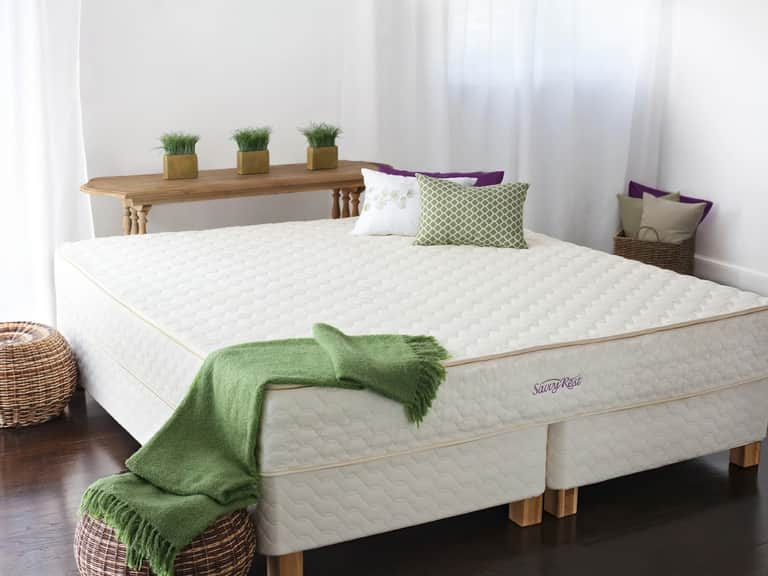
A product such as the Savvy Rest Serenity Latex Mattress illustrates why component-level reading matters: its description identifies latex layers, an organic cotton casing, and organic wool quilting, and references certification for the latex and other materials. For any specific configuration, a reader should still confirm which certifications apply to the chosen layers and request current documentation. The example is not a substitute for checking the certificate’s scope; it is a reminder to trace each material claim separately.
Customization makes this especially important. If firmness options involve different latex layers, ask whether all options share the same certification status. If a mattress has a wool-free alternative, determine whether that changes which standards apply. The construction details and the certification details should be considered together, rather than treating a single label as a summary of every possible configuration.
Organic certification does not decide comfort or durability
Certification can help clarify material sourcing and processing, but it cannot tell you whether a mattress feels comfortable. Comfort depends on factors such as firmness, pressure relief, support, sleep position, body shape, and personal preference. A certified mattress can still be too firm or too soft for an individual sleeper.
Durability is another separate question. It depends on design, material quality, construction, use, foundation support, and care. A certification is not a promise of a particular lifespan unless the relevant documentation explicitly says so. Review warranty terms, return or exchange policies, care instructions, and the construction description alongside the organic claims.
Nor does the word “organic” alone establish a product’s overall environmental impact. Growing methods are one part of a larger picture that can include processing, transport, manufacturing, product longevity, repairability, and end-of-life handling. A careful decision recognizes what the certification can establish without asking it to answer questions outside its remit.
How to assess documentation without getting lost in jargon
Start with the product page, but do not stop at a logo. Look for a certification name written in full, a clear statement of the material covered, and the name of the organization or certificate holder. If the description is unclear, contact the maker or retailer with a focused question: “Does this certificate cover the finished mattress or only the latex core?” A specific question often gets a more useful answer than asking whether the mattress is simply “certified.”
When documentation is provided, check that it matches the product, material, supplier, and time period being discussed. A certificate for a company or facility may not necessarily certify every product made there. Likewise, a certificate for one material should not be treated as proof for another. If the manufacturer offers a public certificate directory or verification method, use it where available.
If a claim cannot be substantiated, treat that as a reason to seek clarification—not as automatic proof of wrongdoing. Businesses may use different documentation formats, and certification rules can be technical. What matters is whether the explanation is consistent, specific, and supported by records appropriate to the claim.
Questions to ask a retailer or manufacturer
- Which parts of this mattress have organic certifications?
- Does the named standard apply to the finished mattress or only to a component?
- Can I review current documentation for the specific material and model?
- Are the available firmness or layer configurations covered in the same way?
- Which materials are not covered by the certifications you list?
- Are any other labels or test reports relevant to emissions or product safety?
- How should I care for the mattress, and what do the warranty terms cover?
A clearer way to choose
Organic mattress certifications are most useful when read as precise statements about defined materials and processes. GOTS may help explain textile claims; GOLS may help clarify latex claims; USDA organic references may describe agricultural production within a particular scope. Each standard has boundaries, and those boundaries are part of the information.
For a confident comparison, map the mattress layer by layer. Identify the material, note the certification attached to it, and confirm what the documentation actually covers. Then assess comfort, construction, care, warranty, and environmental considerations separately. This approach replaces a broad impression with a more complete picture.
In the end, a certification is not a verdict on whether a mattress is right for you. It is a window into part of its making. The more clearly you can see what lies behind each claim, the better equipped you are to choose a sleep surface that fits your priorities—and to know exactly what those labels do, and do not, promise.
Quick reference
- GOTS: A textile standard; check which textile or product scope is covered.
- GOLS: Associated with organic latex; confirm whether it applies to the latex in the specific mattress configuration.
- USDA organic references: May relate to agricultural production or handling; clarify whether the claim concerns a raw material or the finished product.
- Any certification: Verify the exact component, scope, documentation, and limitations before interpreting it as a whole-mattress claim.